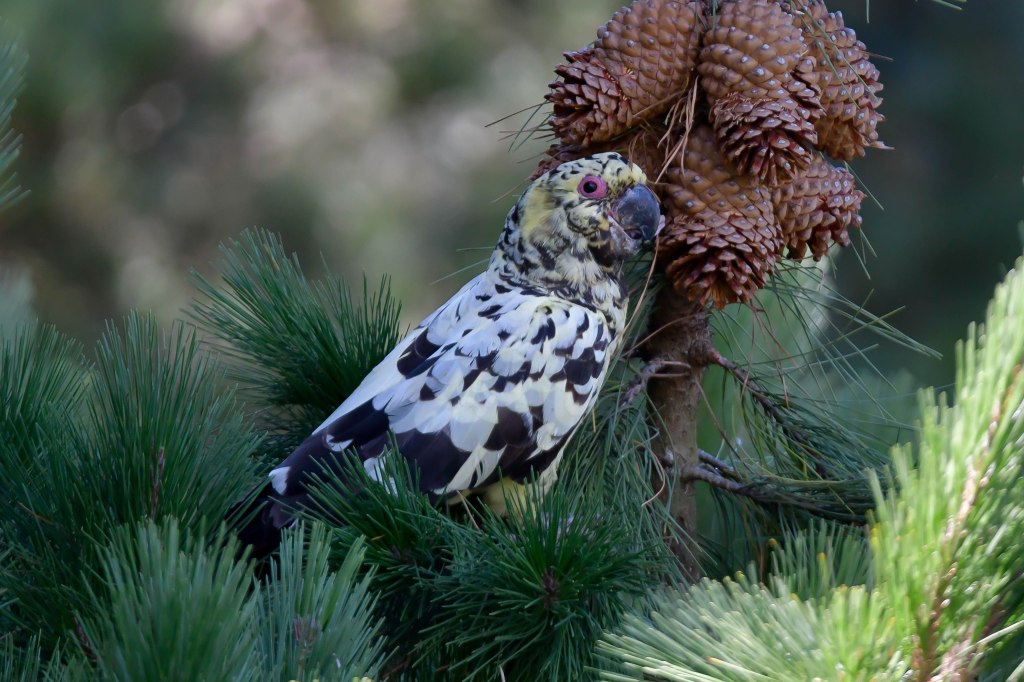
Described as a pied or yellow mutation Yellow-tailed Black Cockatoo, this unusual-looking individual seems to be a regular in the Colac and surrounding area over the past month or so. Possibly the same bird that visited in 2022 (pictured). The male (red eye-ring) Yellow-tailed Black Cockatoo has been seen recently at the Colac Botanic Gardens, Elliminyt, and Barongarook.
Its extra yellow colouring (lack of black colouring) is caused by a genetic condition known as leucism.
Unlike albinism, leucism is a lack of cells responsible for melanin production, the pigment that makes feathers appear dark. Albinism, on the other hand, is a complete absence of melanin, affecting all cells that produce melanin, including the eyes, which would be a pink or reddish colour. Leucism does not affect the eyes and can have some unaffected feathers that remain the normal darker colour. Leucism can be caused by a variety of factors, such as genetic mutations, environmental influences, developmental defects, or even injury. Partial albinism is not something that happens. Species that have naturally occurring yellow, orange and red colours produced by carotenoid pigments will maintain the ability to produce those colours in their plumage. Carotenoids are obtained through diet, whereas melanin is produced in the body.
Sightings like this are not uncommon, estimates say one in thirty thousand, in the wild and affect many species of cockatoos and parrots.
Leucistic birds have a battle on their hands from a young age and usually do not make it past fledgling. Standing out in the crowd makes them a target for predation. The lack of pigment can weaken feathers, causing them to wear out faster and hinder flight. They can have trouble finding a mate and issues with thermoregulation for species that sunbathe.
Published: 07/05/2025

 Colac Birder