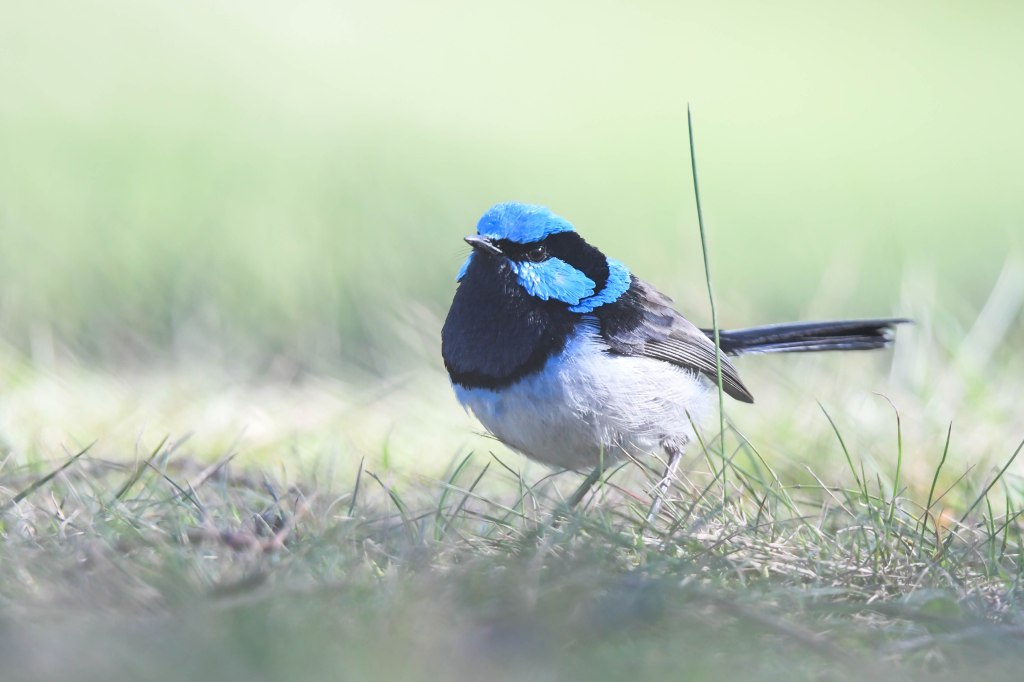
The Superb Fairywren (Malurus cyaneus), or Blue Wren, is a small shrub-dwelling species, inhabiting a wide range of open forests, coastal scrub and urban gardens of Southeastern Australia. The males’ vibrant blue colour grabs attention as they perch atop a small shrub and sing their little hearts away.
With a variety of rapid trills, subtle buzzing, purring and an abrupt alarm call, this tiny blue songbird is a favourite to many, winning Birdlife Australia’s Bird of the Year in 2021.
The Australian Wren family, Maluridae, has 16 Fairywren species, 3 Emuwrens and 13 Grasswrens. The Superb Fairywren has 6 subspecies.
Very active, they’re often seen chasing each other, vocalising and hopping around looking for food, they barely stopping for a moment. Feeding mostly on insects, some seeds, flowers and fruit.
They live in socially monogamous pairs with 1 or more helpers. Although studies have shown, both males and females are promiscuous, with roughly 75% of socially bonded pairs raising the offspring of an outsider male. During the reproductive season, males are known to collect yellow flower petals that contrast with their plumage. Showing them to a female of their own or another territory as part of a courtship display.
The bond group keep close, partake in mutual preening, shelter and roost side by side.
A breeding adult male has a blue cap, matching blue cheeks and back, a black band through the eyes, blue-black throat and bib, brown wings, black bill and legs and a navy-blue tail and white underparts. Once breeding season is over, they moult into a non-breeding plumage, known as eclipse plumage, which is a dull grey brown all over, maintaining the black bill, legs and navy-blue tail. Adult females are similar to non-breeding males, although females have an orange-red bill and around the eyes, with a light blue-grey tail. Juveniles are the same as adult females, except they have a brown tail with no blue.
Published 08/09/2025

 Colac Birder