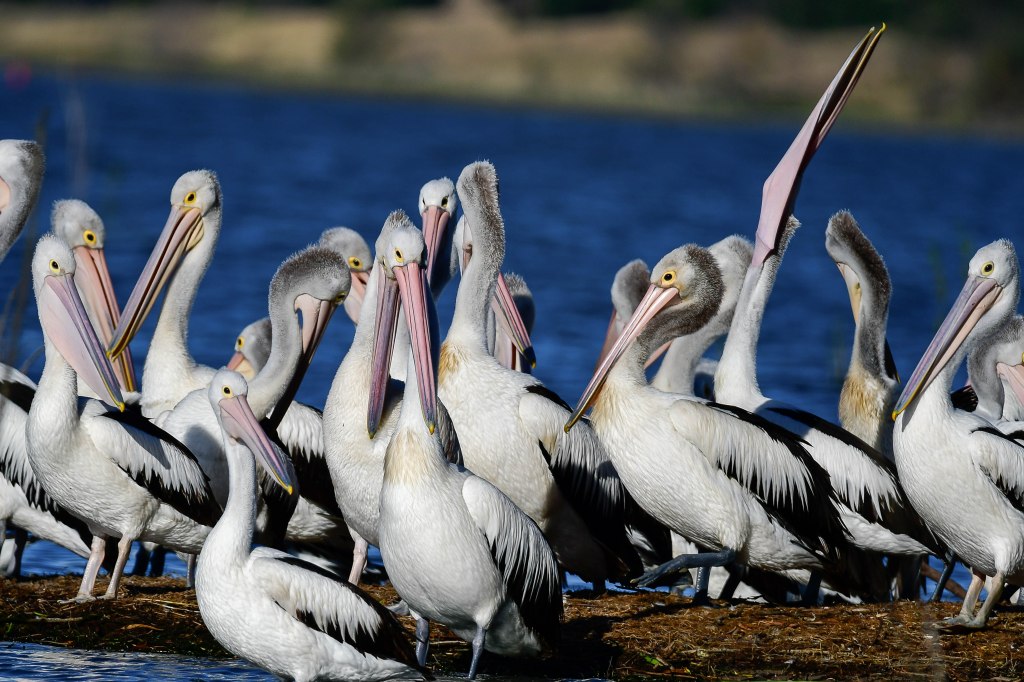
The Australian Pelican, Pelecanus conspicillatus – is 1 of 8 members of the Genus Pelicanus and is the largest flying bird in Australia with a wingspan of up to 3 metres.
It has the longest bill of any bird in the world, measuring up to 47cm, with a large bill pouch that holds up to 13 litres, used like a net to trawl for fish, crustaceans, tadpoles and turtles.
Pelicans often feed in large groups. Circling and herding fish into shallow waters, where they synchronise dipping their bills into the water for maximum catch.
Australian Pelicans are very common throughout Australia and often seen in large flocks. They usually breed after heavy rains and nest on remote islands and secluded shorelines in large colonies. They synchronise nesting, with the majority laying their 1-3, usually 2 eggs, within 10 days of each other. The nest is made of a shallow scrape lined with seaweed and feathers or a trampled shrub. The colonies can be very large, sometimes tens of thousands of birds.
Only the strong survive. Known as siblicide the larger chick will attack, dominate and outcompeting the smaller one for food. The surviving chicks are sometimes left to form a large creche of up to 100 birds, being cared for by a few adults while the other parents go in search of food.
Pelicans are not capable of sustained flapping flight but circling on warm air thermals, they are masters and can reach heights of more than 3,000 metres with ease. Moving from thermal to thermal they can cover vast distances at speeds of more than 50km per hour.
Pelicans are often seen gliding low over water, with very little effort. Which is another effective use of air pressures. The air compressed between the wings and the water surface, creates a cushion of high pressure that increases lift and reduces drag, once again, allowing them to cover long distances with minimal effort.
Published – Dec 2025

 Colac Birder