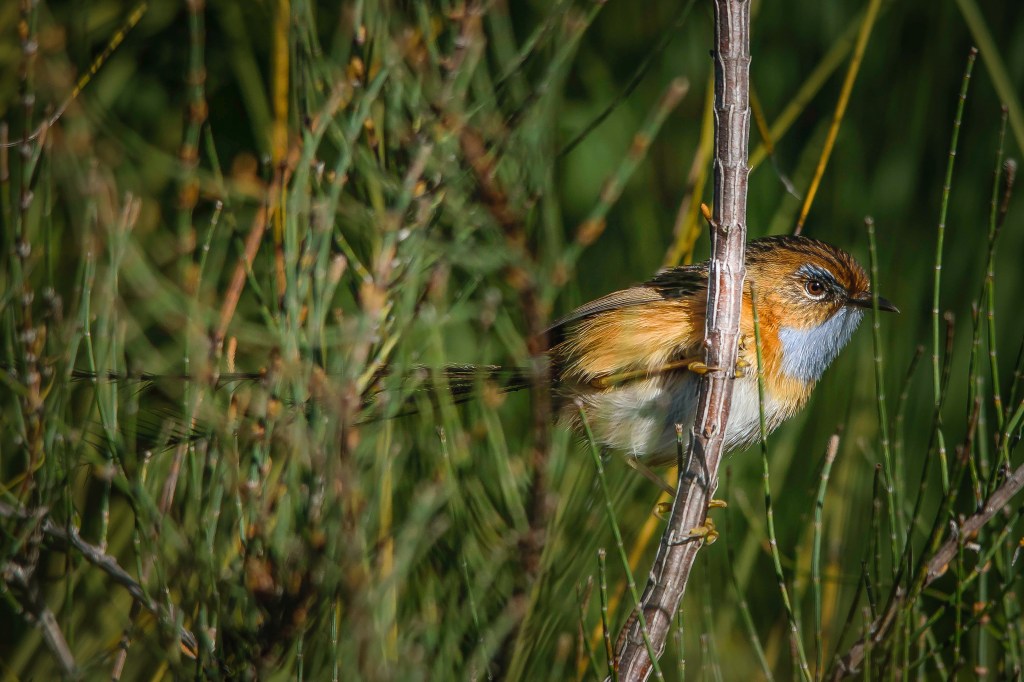
Southern Emuwren, Stipiturus malachurus, is a beautiful little species in the Australian wren family, Maluridae. 1 of 3 Emu-wren species, including Malee Emu-wren and Rufous-crowned Emu-wren.
The Southern Emu-wren is notably shy and cryptic, often skulking in coastal heath, swamps, thick scrub or tea-tree vegetation and is not well known to those outside bird enthusiast, environmentalist, scientific and conservation communities. Usually difficult to find and tricky to observe. A jewel in birdwatching groups, with many avid twitchers excited to find and photograph.
Southern Emuwrens can be found from Southeast Queensland, down through coastal New South Wales, across the bottom of Victoria, western Tasmania, parts of southeast South Australia and Southwest Western Australia. Although widespread, at least 2 of the 8 subspecies are considered endangered due to habitat fragmentation, predation by cats and foxes and bushfires.
The adult male is a bright rusty red colour with black streaks, a pale underbelly, and sky-blue throat and eyebrows. The female is a warm, buff-brown with darker streaks. Both sexes have a long, filamentous tail of 6 feathers, which look strikingly similar to those of an emu, and roughly double the length of their mouse-sized body. The tiny bird weighs in at 7 to 8 grams, about the same as a teaspoon of sugar, making them one of Australia’s lightest birds.
They lay 2-4 brown speckled, roughly pea-sized eggs. The female incubates the eggs, while the male brings food of insects and spiders. The chicks hatch out within 12-15 days, and both parents care for them until they are fully fledged, within about 3 months.
Places you may find them are Coastal Heathlands and thick scrub near the coast, tea-tree heaths, and areas of scrub with grass trees.
Published – Jan 2026

 Colac Birder