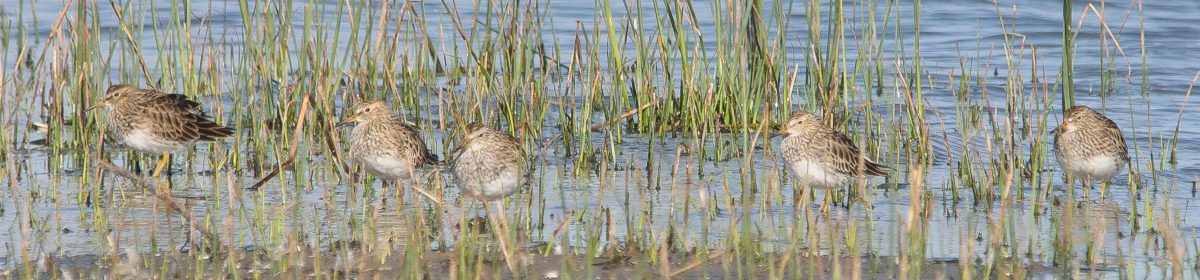
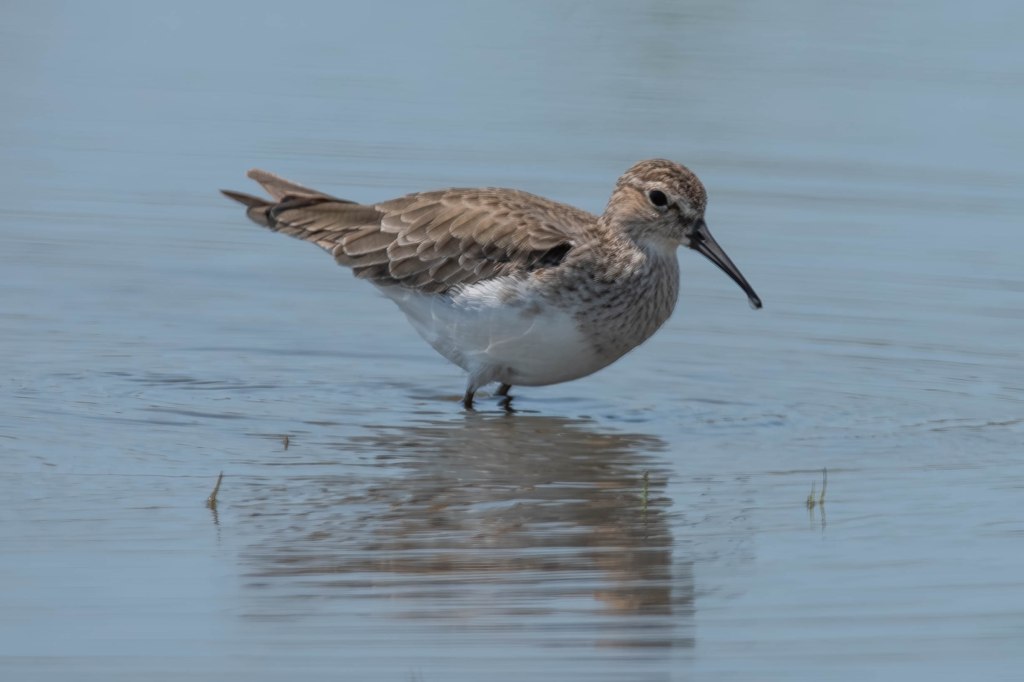
Cox’s Sandpiper – (Calidris ferruginea x melanotos) is a rare and intriguing hybrid shorebird. The resulting offspring of a male Pectoral Sandpiper (Calidris melanotos) and a female Curlew Sandpiper (Calidris ferruginea).
Discovered in Australia in the 1950’s and originally identified as Australia’s first record of a Dunlin (Calidris alpina), a similar-looking migratory wader normally found in western Europe.
As records accumulated, questions arose, as it did not quite fit with the standard Dunlin profile. It wasn’t until 1975 and 1977 that ornithologist John Cox collected 2 specimens for the South Australian Museum, which began the process of solving the mystery of these ill-fitting individuals. In 1981, the two specimens were sent to the American Museum of Natural History for comparison to a similar and extremely rare specimen known as ‘Cooper’s Sandpiper’, named in 1833 (now believed to be a hybrid of Curlew and Sharp-tailed Sandpiper). Cox’s specimens were found to be not the same as the Cooper’s Sandpiper, and in 1982, with photography and the collection of a live specimen, the Cox’s Sandpiper (Calidris paramelanotos) was declared. Subsequently, all previous Australian records of Dunlin were removed, although it has since been recorded as a genuine vagrant to Australia.
In the mid-1980s, the Cox’s Sandpiper began appearing in field guides, although some believed a hybrid status had not been ruled out.
Similar in size to other calidris species, Cox’s has a long, blackish, slightly drooping bill, dull brownish-green legs, and wings at rest slightly extend beyond the tail. Brown-grey above and white below, with a brown-grey breast-band and no flank-streaks.
John Cox, in 1990, re-examined the specimen of ‘Cooper’s Sandpiper’, the feather patterns of Cox’s, Cooper’s, Sharp-tailed and Curlew Sandpipers, and published a paper concluding that all Cox’s and Cooper’s were probably hybrids.
In 1996, it was put to bed when three Cox’s Sandpiper specimens underwent analysis of their mitochondrial DNA, which showed that all three were the result of mating between a male Pectoral and a female Curlew Sandpiper, and the Cox’s Sandpiper was officially removed from bird lists and taxonomic records as a species.
Hybridisation between waders is rare and poorly documented, and many calidrids are similar-looking and closely related. It’s easy to see how such errors in formal identification can be made.
It is estimated that there are only one or two Cox’s Sandpipers in existence at any one time, with roughly 40 ever recorded. On 25/01/2026, a Cox’s Sandpiper was confirmed at Lake Colac’s NW shore (pictured).

 Colac Birder