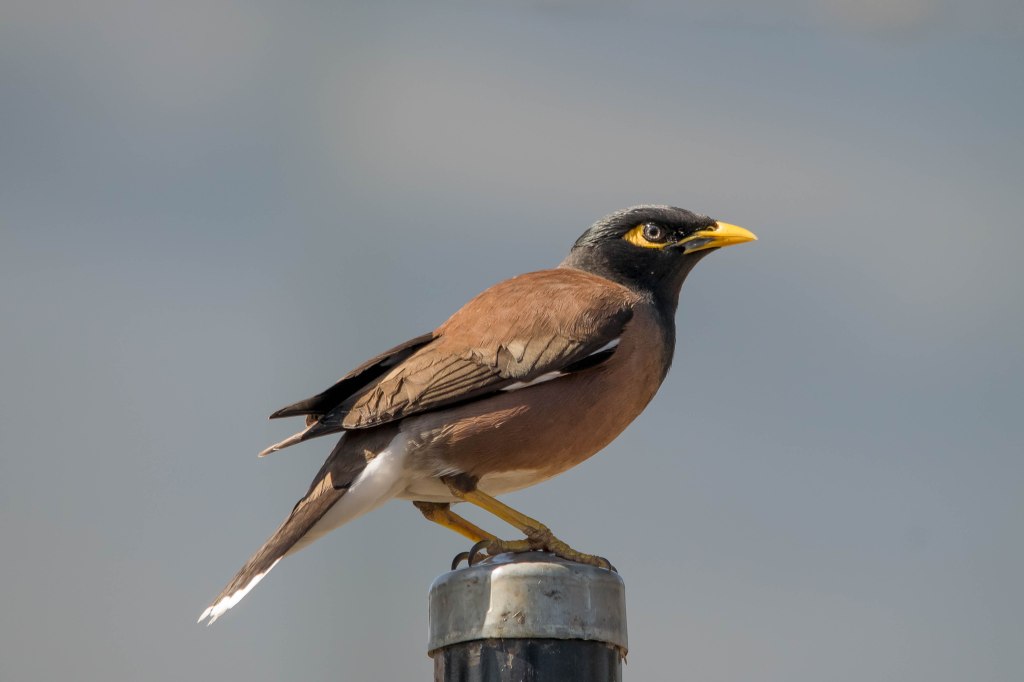
Common Myna or Indian Myna/Mynah (Acridotheres tristis)
A raucous songbird, with whistles, squawks, clicks, chirps and growls. The Myna has a distinct brown body, black head, yellow eye-patch, bill and legs, with a white underwing and undertail.
Originating in Asia, the Myna inhabits India, Thailand and surrounding Countries. In the 1860s, it was introduced into Melbourne to control insects. Then spread to Sydney around the same time, forming strong populations in and around both major cities. In 1883, it was introduced to Queensland to control grasshoppers and cane beetles. It has since been considered invasive in Australia and many other countries throughout the World. They are aggressive, driving down the number of native species and often the predominant bird in many urban areas along the East Coast of Australia.
Often seen aside major arterials, their population bubble has pushed beyond Geelong, Ballarat and many small country towns hundreds of kilometres from the introductory point in Melbourne. In recent years, the relentless pest has been seen at Birregurra, Warncoort, Cressy, and many locations along the Colac-Ballarat Road and beyond.
They nest in protected hollows found naturally in trees or artificially in buildings and actively defend their nesting areas. They are extremely territorial, hostile towards other birds and drive away other hollow-nesting species. They are regularly seen taking over nests and hollows, destroying eggs and killing the young of native hollow-nesting species. Leading to further exclusion of native species and impacting biodiversity.
They feed mostly on ground-dwelling insects, some fruits and cereals, and in urban areas, pet food that is left out, and discarded human food scraps. They are known to cause significant damage to ripening fruit and cereal crops, contaminate feed stocks and damage vegetables and other crops. They are also known to spread weeds and invasive plant species, carry disease, and have parasites.
Pest management strategies have significantly reduced Myna populations and increased the biodiversity of native birds. Management involves reducing their attractions, blocking nesting and roosting areas, trapping and euthanasia.
Published: 11/06/2025
 Colac Birder