The Great Crested Grebe (Podiceps cristatus) and subspecies, Australasian Crested Grebe (Podiceps cristatus ssp. Australis) are a fascinating native species with an interesting, somewhat mesmerising courtship display and adorable nursing method.
There are 22 Grebe species in the world, in a taxonomic order (Podicipediformes) and family group (Podicipedidae) of their own. Confirmed by DNA and physical morphological evidence, surprisingly their closest relative is the Flamingo.
Of the 3 species of Grebes found in Australia the Great Crested Grebe is the largest, roughly double the size of the Hoary-headed and Australasian Grebes.
Grebes in general have a lot of feathers, averaging around 20,000, the most of all birds. Their feathers are extremely dense and curved, providing good insulation and streamlining, for diving under water for their main diet of fish. Their feathers also form a specialised pouch on their backs for carrying chicks, known as Greblettes or Grebelings.
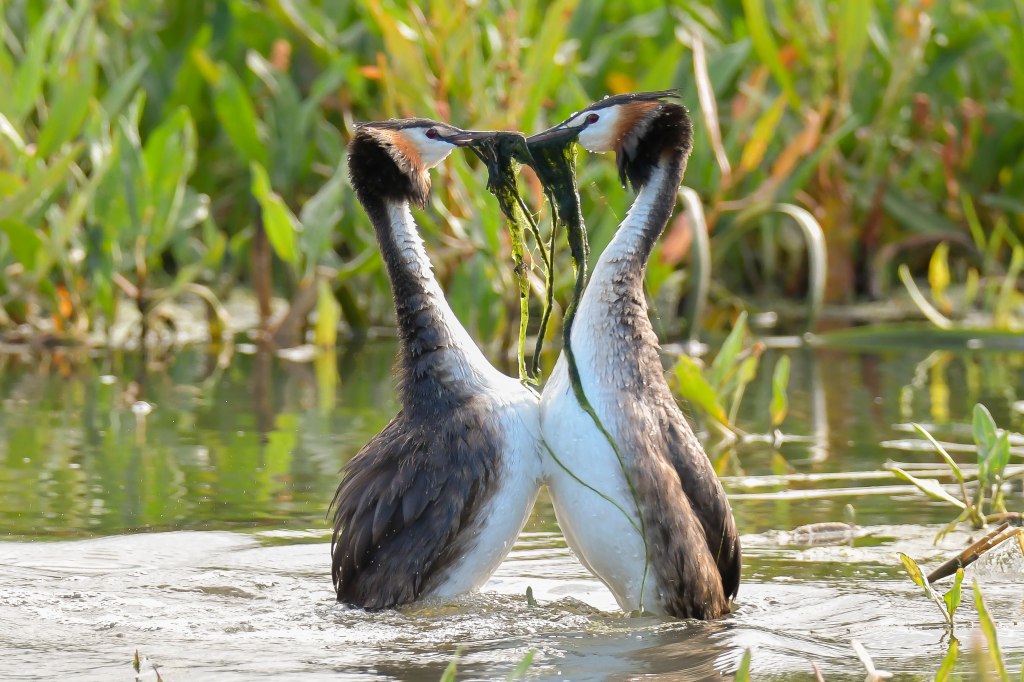
In early Spring with their breeding plumes of fiery orange cheeks and black ear-like flares they begin to pair off. The elaborate courtship begins with a head bobbing and tilting duet to signify compatibility. All going well, they rush off, paddling furiously, they run on the water surface. Their bodies lifted completely out of the water as they dart along side by side. Then at a suitable nesting site they collect aquatic vegetation and present it to each other. As they face each other they paddle again, and their bodies rise out of the water (pictured above) in a ritual known as the “weed dance” or “Penguin dance” a form of courtship or to reaffirm their bonds.
Great Crested Grebes are monogamous, maintaining their mate throughout the year. After the dance, mating is a mere formality, and they build a nest on floating vegetation. Both parents share the responsibility of defending the territory, incubating the eggs and caring for the chicks. They lay between 2-5 eggs. In lasting conditions, Grebes can have up to 3 broods in one season.
Published – 08/10/2025
 Colac Birder