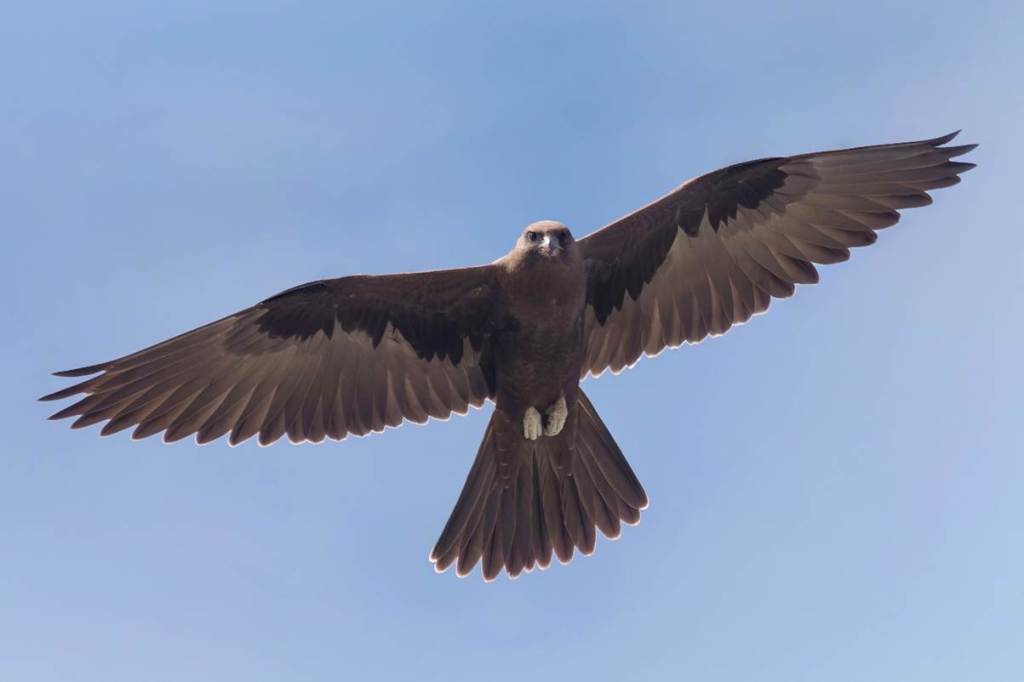
The Black Falcon – Falco subniger is a fascinating bird of prey, only found in Australia. It belongs to the family Falconidae, which has 6 members in Australia and roughly 65 globally. The Australian species include Brown Falcon, Grey Falcon, Peregrine Falcon, Nankeen Kestrel and Australian Hobby.
Black Falcons are uncommon and found in mostly arid areas of the mainland, usually not far from water, low vegetation, and often base their activities from a small, isolated woodland.
They are Australia’s largest falcon and least studied, as they’re often overshadowed by the popular Peregrine Falcon, and confused with the similar, but more common Brown Falcon. The Brown Falcon’s colour varies considerably, from very light brown to very dark brown.
Black Falcons are dark brown to sooty black, with young birds generally darker than adults. The underwing usually has lighter coloured flight feathers. Some birds have a white chin, lightly barred flight feathers and undertail. Legs, talons, and around the eye (cere) are grey to grey-blue. Some birds have a noticeable cheek patch. The beak and talons are black.
The easiest way to identify a dark falcon is by the tarsus (lower leg). The Brown Falcon has an exposed tarsus, whereas the Black Falcon has feathers covering the tarsus, commonly referred to as trousers.
They nest in pre-built stick nests of other species, either old abandoned nests, or they drive out the previous owner, being another large falcon or corvid species. They usually lay 3-4 eggs, which the female incubates for around 5 weeks. The male brings the female food during incubation, and both sexes feed the young.
They hunt rabbits, mice, and a variety of bird species, usually under half their size, and they supplement their diet with insects. Young birds learn to catch insects before taking larger prey.
Places you may find Black Falcon nearby are farmland north of Lake Colac, Irrewarra, around Beeac, Cundare and around Cressy.
 Colac Birder