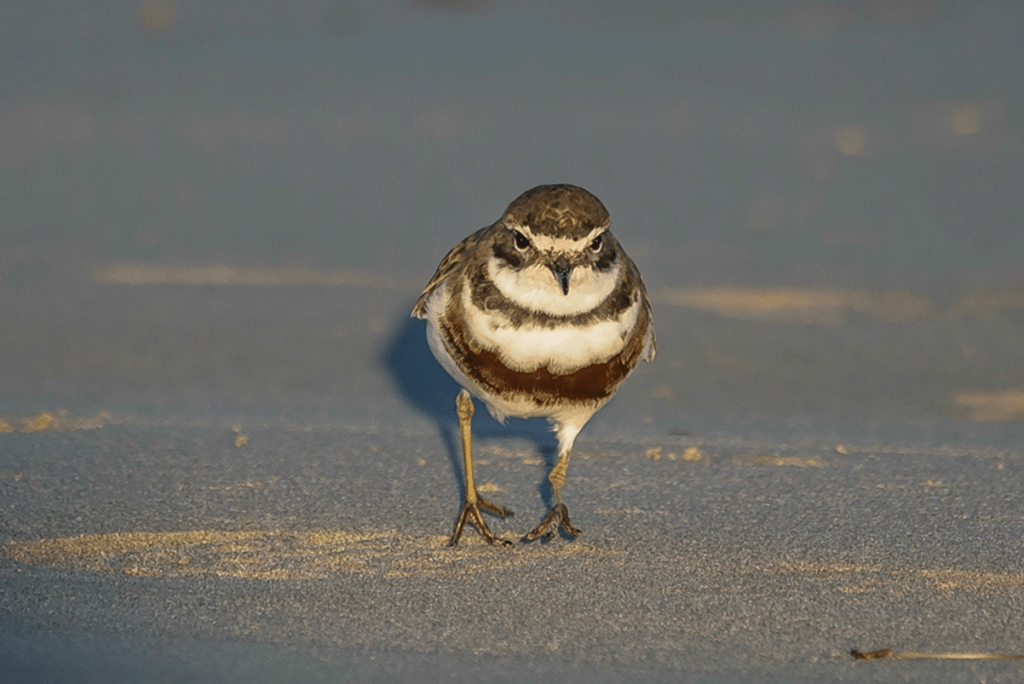
The Double-banded Plover, Anarhynchus bicinctus, is an exceptional shorebird, known as the only east-to-west migratory wader.
While other waders are moving north, towards the Northern Summer breeding grounds of the Arctic tundra in Russia and Alaska, the Double-banded Plover is travelling west from New Zealand to Victoria, Tasmania and other Southeastern states of Australia.
Most of these trans-Tasman migrants are from the highlands of New Zealand’s South Island, which is often covered in snow throughout Winter.
There are 2 recognised subspecies of Double-banded Plover, the New Zealand Double-banded Plover, Anarhynchus bicinctus bicinctus, and the Auckland Island Double-banded Plover, Anarhynchus bicinctus exilis, and the difference is remarkable.
The Ssp. bicinctus, New Zealand Double-banded Plover breeds throughout the North and South Islands of New Zealand, and other surrounding islands, with a large proportion of more than 60% of adults migrating annually to Australia.
After breeding, when the chicks have become independent, adult Ssp. bicinctus move to nearby coastal locations, usually around Autumn, before launching their 1,600 km flight to Australia. Once in Australia, they spend the non-breeding season, Autumn to Winter, at various beaches, mudflats, lake edges and farmland paddocks, feeding on molluscs, insects, crustaceans, marine worms, spiders, seeds and berries until late Winter, before catching a favourable westerly returning to their breeding grounds in New Zealand.
Ssp. exilis, Auckland Island Double-banded Plovers are up to 30% larger, have longer legs and are considered sedentary, remaining at their breeding territory or nearby tidal shores, within the Auckland Islands. With many individuals spending Winter on the shores of Enderby Island at the Northern end of the Auckland Islands, which is approximately 465 kms south of New Zealand’s South Island.
The Double-banded Plover is listed as near threatened due to declining numbers.
During the next few months, they may be found at coastal beaches such as Apollo Bay, Johanna and Anglesea, Lake Colac, Lake Corangamite, Cundare Pools and other suitable habitats.
 Colac Birder